
Bosphorus Dinner Cruise | Private Tables | Standard Menu Unlimited Soft Drinks | Hotel Transfer
19 October 2026
|
3 Hours
Free Cancellation & Refund.
Departure Points
- Mega Lüfer Yachts Kabataş Pier
- Hotel Name (Required for Transfer Package)
Tour details
In this option, standard menu, unlimited soft drinks, and hotel transfer are included
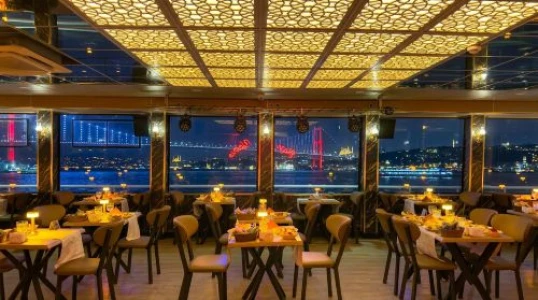
Experience an unforgettable Bosphorus evening with a 3-course dinner cruise, live show, and your own private table, accompanied by Istanbul’s dazzling skyline.
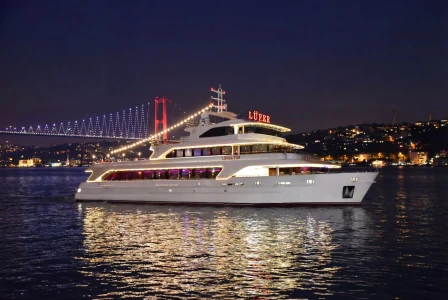
With Mega Lüfer Yachts, experience one of Istanbul’s most iconic evening events: the Bosphorus dinner cruise. This unforgettable night combines panoramic Bosphorus views, freshly prepared dinner served at your private table, and a lively, energetic show featuring traditional Turkish performances.
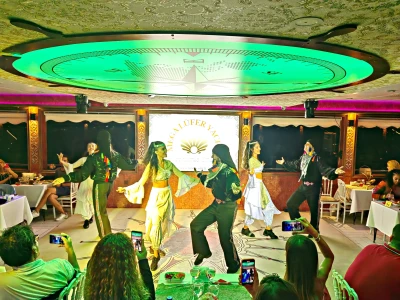
As the boat sails between Europe and Asia, take in Istanbul’s illuminated bridges, palaces, and waterfront mansions reflected on the water. Throughout the evening, enjoy the professionally staged Turkish night show, bringing the atmosphere to life with music, dance, and cultural performances.
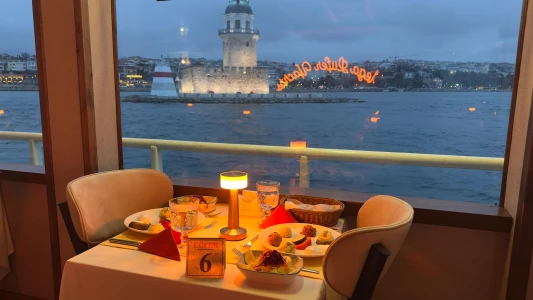
Your private table seating ensures comfort, personal space, and uninterrupted enjoyment, allowing you to relax throughout your cruise. Whether you are celebrating a special occasion or simply looking for a unique night out, this Bosphorus dinner cruise on Mega Lüfer offers the perfect balance of dining, entertainment, and scenery.
NOTE: To join our tours from the Asian Side, you can use the Üsküdar-Kabataş City Lines ferries. Services operate both ways from 09:20 in the morning until 00:15 at night, every 15 minutes: The one-way fare for Üsküdar-Kabataş is 110 TL by credit card and 47 TL with Istanbul Card
What's included
STANDARD MENU
WELCOME COCKTAIL
HORS D'OEUVRES / COLD STARTERS
6 Varieties of Mixed Turkish Meze
Bulgur Salad
Broad Bean Fava
Spicy Mashed Salad
Vegetable Salad
Orzo Salad
Potato Salad
HOT STARTERS
Vegetable-Filled Paçanga Pastry
MAIN COURSES
(Optional)
Beef Stroganoff (julienne-cut) served on a bed of purée, accompanied by a side of rice pilaf
or
Chicken sauté with tomatoes and peppers, served on a bed of mashed potatoes, accompanied by rice pilaf and a side garnish
or
Grilled Tomatoes with Pepperor or Fish (Seamea)
with salad, potato salad and lemon
or
Vegetarian Vegetable and Italian Pasta Types
SALAD
Seasonal Salad
DESSERT & FRUIT
Seasonal Fruit and Baklava
Unlimited Tea, Coffee and Soft Drinks
✅ 3-Hour Evening Bosphorus Cruise
✅ Private table
✅ Welcome Cocktail
✅ Standard Dinner Menu
✅ Unlimited Non-Alcoholic Beverages
✅ Live Turkish Music, Oriental Dance Show, Turkish Folk Dance Performances
✅Hotel Pickup and Hotel Drop-Off Transfer Areas: Topkapi Aksaray Yenikapi Laleli Beyazit Kumkapi Kadirga Sultanahmet Sirkeci Mecidiyekoy Sisli Taksim Galata
Not included
Extra alcoholic beverages (available depending on the selected option),
tips,
Need to Know
Free cancellation up to 24 hours before the experience begins
Tickets purchased less than 24 hours before the tour start time are considered firm reservations. Cancellations, changes, and refunds cannot be made for these reservations.
For same-day transfers, reservations must be made before 18:00.
- Cancellation 24 hours or more before the tour time: 100% refund (within 2-7 business days via Iyzico).
- Cancellation less than 24 hours before or no-show: No refund.
- Weather conditions / operational cancellation: Alternative date or 100% refund.
- Please be at the relevant pier/meeting point 30 minutes before boarding time; the boat departs at the scheduled time.
- A valid identification document for all guests (T.C. identity card / passport / driver’s license) is required.
- Children aged 0-3 free (on lap), 3-7 discounted, 7+ adult rate. Guests under 18 must be accompanied by a parent/guardian.
- Guests under the influence of excessive alcohol/drugs will not be allowed on board; in case of behavior that violates the rules, the captain has the authority to disembark the guest (no refund).
- No outside food/drinks may be brought onto the boat; products are served from the boat bar. Smoking/e-cigarettes are prohibited on board.
- If operationally necessary, the departure pier or time may change; in this case, notification is made by email/SMS at least 6 hours in advance.
- Guests who are pregnant, have serious heart/back conditions, or mobility limitations should contact us before making a reservation.
- Guests are responsible for their personal belongings; our company cannot be held responsible for items forgotten/lost on board.
- Payments are collected via the PCI-DSS certified Iyzico infrastructure with 3D Secure; your card information is not stored on our servers.
Tour Program
Kabataş
Kabataş, departure point of Mega Lüfer Boats
Dolmabahçe Palace
Dolmabahçe Palace was built as the main administrative center of the Ottoman Empire and served as the residence of the Sultan and his family until its decline in 1922. It is a magnificent 19th-century palace that showcases an interesting combination of Ottoman, Baroque, and Neoclassical styles. With over 285 rooms, 46 halls, 6 baths, and splendid gardens, it ranks among the largest palaces in the world.
Dolmabahçe Mosque
The real name of Dolmabahçe Mosque is Bezmialem Valide Sultan Mosque. Built by the mother of Sultan Abdülmecid in 1852 and completed in 1855, this mosque possesses a sacred significance and a unique architecture that necessitated its proximity to the Palace while also requiring it not to be inside the Palace. With intricate details and soaring minarets, the mosque beautifully combines Baroque and Ottoman architecture, showcasing the mesmerizing grandeur of the 19th century.
Beşiktaş
Beşiktaş
Feriye Mansion
The first palace built along the shores of the Bosphorus in Istanbul for the Ottoman Dynasty was the Dolmabahçe Palace, which was inaugurated in 1856. Subsequently, the Çırağan Palace was established in 1872. However, these two palaces were insufficient to meet the needs of the Ottoman family, so additional structures were built along the shoreline between the Çırağan Palace and the Ortaköy Mosque. These structures, designed by architects from the Balyan family, are known as the Feriye Palaces, meaning secondary or auxiliary buildings.
Çırağan Palace
Çırağan, the area between today's Beşiktaş and Ortaköy, was called "Kazancıoğlu Gardens" in the 17th century. In the 18th century, seaside palaces and gardens along Beşiktaş shores, with sea views, were among the most important symbols of the era known as the Tulip Era, a period celebrated for its love of flowers and music. This period was not only an enjoyment but also a time of cultural brilliance. The reigning sultan of that time, III. Ahmed, gifted his estate to his loyal vizier İbrahim Paşa, and the first yalı (waterside mansion) was built by Nevşehirli Damat İbrahim Paşa for the sultan's daughter, Fatma Sultan. İbrahim Paşa organized fireworks festivals known as Çırağan Celebrations here. For these reasons, over time, this area came to be known as 'Çırağan', a name that means 'lights' in Persian.
Ortaköy
Ortaköy
Ortaköy Mosque
Cami was built in 1853 by Ottoman Sultan Abdülmecid for Armenian architect Nigoğos Balyan. It consists of two main parts: the harim and the hünkar section, in accordance with the general structure of sultanate mosques. Its wide and tall windows are designed to allow the varying lights of the Bosphorus to enter.
Access to the structure is via stairs, and it has two single-bald minarets. The walls are constructed from white cut stones. The interior of the single dome is decorated with pink mosaics. The mihrab is made of mosaic and marble, while the minber is crafted from hard marble cladding, exemplifying meticulous and detailed craftsmanship.
Bosporus Bridge
15 July Martyrs' Bridge, formerly known as Bosphorus Bridge and halk arasında Birinci Köprü (First Bridge), is an important suspension bridge located over the Bosphorus in Istanbul, connecting the Black Sea and the Sea of Marmara. The bridge's piers are situated in Ortaköy on the European side and Beylerbeyi on the Asian side. Being the first bridge built over the Bosphorus, it is also known as the First Bridge. Along with the Fatih Sultan Mehmet Bridge, Yavuz Sultan Selim Bridge, and the Eurasia Tunnel, it provides uninterrupted road transportation between the two sides of the city. Construction of the bridge began on February 20, 1970, and it was officially opened on October 30, 1973, by then-President Fahri Korutürk in a state ceremony, coinciding with Turkey's 50th anniversary of its founding.
Kuruçeşme
Kuruçeşme
Bebek
Bebek
Egypt Consulate General
The building of the Egyptian Consulate, Hıdiva Yalısı or Ali Pasha Yalısı, is an impressive mansion located in the Bebek neighborhood of Beşiktaş district in Istanbul. Situated right in the middle of Bebek Bay, this yali currently serves as the Istanbul Consulate General of Egypt. It was designed in 1902 by the renowned Italian architect Raimondo D'Aronco as a summer residence for Emine Valide Pasha, the mother of Hüdiv Abbas Hilmi Pasha. The lush wooded area behind it is known as Kortel Grove, belonging to Professor Fikret Kortel of Boğaziçi University. The existing structure was built in the early 20th century. After the proclamation of the Republic, Emine Valide Pasha donated this unique building to the Egyptian Government. The building was vacated in 2002 and underwent extensive restoration between 2008 and 2011.
Rumeli Fortress
The fortress located on the Bosphorus coast in the Sarıyer district of Istanbul, which bears the name of its neighborhood, holds historical significance. Sultan Mehmed the Conqueror built it before the conquest of Istanbul to eliminate potential threats coming from the Black Sea, at the narrowest point of the Bosphorus (698 meters), opposite the Anadolu Hisarı on the Anatolian side. The fortress covers an area of 32,000 square meters. Constructed in a short period of ninety days, this structure has three large towers, some of the largest castle battlements in the world. Rumeli Hisarı is referred to as Kulle-i Cedide in the sultanic foundations; Yenice Hisar in Neşri's historical writings; and Boğazkesen Hisarı in the documents of Kemalpaşazade, Aşıkpaşazade, and Nişancı.
Anatolian Fortress
Anadolu Hisarı Fortress, also known as Güzelce Hisarı, is an Ottoman fortress located in the Anadoluhisarı neighborhood of Beykoz district in Istanbul, at the site where the Göksu River flows into the Bosphorus. Anadolu Hisarı covers an area of 7,000 square meters and was built in 1395 by Yıldırım Bayezid at the narrowest point of the Bosphorus, which is 660 meters apart. The Genoese, allied with the Byzantines, established colonies in the Black Sea region (Kefe, Sinop, and Amasra). Therefore, passage through the strait was vital for the Genoese. The same was true for the Ottomans. On the opposite shore, on the European side of Istanbul, Rumelihisarı was constructed between 1451 and 1452 by Mehmed the Conqueror to monitor the passage of foreign ships. Sultan Mehmed the Conqueror added outer walls to this fortress during its construction.
Göksu Stream
Göksu Stream is a creek that flows into the Bosphorus between Anadoluhisarı and Göksu neighborhoods in Beykoz, Anatolian side of Istanbul. It originates from the convergence of flood channels descending from the southern hills of Göztepe and curves gently in a hilly area, draining into the sea along the northern edge of the plain called Küçüksu Field. The Küçüksu Stream also passes along the southern edge of this plain and reaches the sea near Küçüksu Pavilion. These twin waters are called "Fresh Waters of Asia" in Western languages. This name derives from the Byzantine period name Potamion (meaning small river), given to Göksu. During the Ottoman period, Sultan IV. Murad named it "Gümüş Servi" (Silver Cypress) because of the cypress forests extending to Kandilli at that time.
Küçüksu Pavilion
Küçüksu Pavilion or Göksu Pavilion is a historic building located in the Küçüksu neighborhood of Istanbul, between the Göksu River and Küçüksu River, on the Bosphorus along the Üsküdar-Beykoz shoreline. It was commissioned by Sultan Abdülmecid and built by Nigoğos Balyan, with construction completed in 1856. Formerly known as "Göksu Pavilion," this structure is one of the Bosphorus shoreline retreat pavilions for sultans. These pavilions are large structures built outside the palace and are considered the private property of the sultans. Not used for permanent residence, these pavilions served as places where sultans preferred to relax.
Çengelköy
Çengelköy
Kuleli Military High School
II. When Mehmed conquered Istanbul, there was a grove, a monastery, and a tower in the area where the Kuleli Military High School is now located. Between 1512 and 1520, during the reign of Yavuz Sultan Selim, this monastery was allocated as barracks for Janissaries. Over time, this barracks area became known as Bostancıbaşı Rooms, and due to the beauty of the garden, it was recognized as Kuleli Garden. As soon as Sultan Süleyman became sultan, a large nine-story mansion with a tall tower was built in the garden; each floor was equipped with spring-fed pools. Sultan Ahmed III turned the tower garden and its surroundings into private property. During this period, a tower from the Byzantine era was demolished. In 1744, a mosque was built along the shoreline by Kaymak Mustafa Pasha, the son-in-law of Grand Vizier Nevşehirli Ibrahim Pasha.
Beylerbeyi
Beylerbeyi
Beylerbeyi Palace
Beylerbeyi Palace is a summer residence of the Ottoman Empire located in the Üsküdar district of Istanbul. Today, it functions as a museum and is part of a complex consisting of various structures and elements. It is named after the Beylerbeyi neighborhood. Built between 1863 and 1865 under the orders of Ottoman Sultan Abdulaziz, it was designed by architect Sarkis Balyan.
Üsküdar
Üsküdar
Maiden's Tower
Following the naval victory at Cyzicus, in 408 BC, the Athenian general Alcibiades possibly built a special lookout station on a small rock off Üsküdar, likely for ships coming from the Black Sea. The tower, which has become the symbol of Üsküdar, is the only remaining structure from the Byzantine period, with a longstanding history dating back to 24 BC. In 1110, Byzantine Emperor Alexios I constructed a wooden tower reinforced with stone walls. From this tower, an iron chain was stretched to another tower built in the Mangana district of the historic peninsula. The islet was later connected to the Asian coast by a defense wall, along with submerged relics. During the Ottoman conquest of Istanbul in 1453, the tower housed a Byzantine garrison led by Venetian Gabriele Trevisano. Subsequently, during Sultan Mehmed the Conqueror’s reign, the structure was used by the Ottoman Turks as a watchtower.
Galata Port
Galataport is a cruise port and mixed-use facility located in Karaköy, Istanbul. Situated on the European side of the Bosphorus, at the point where the Golden Horn merges with the Bosphorus Strait. It is located along a 1.2 km long coastline on the Bosphorus. The facility includes a hotel, cafes, restaurants, boutique shops, offices, and two art museums. Galata Rıhtımı is Istanbul's and Turkey's first modern quay. It extends from Galata Bridge toward Fındıklı along the Karaköy waterfront. Construction began in April 1892 under the leadership of Mişel Pasha and was completed at the end of 1895. It is 758 meters long. Together with Salıpazarı Rıhtımı, it constitutes the Istanbul port. It is managed by the Turkish Maritime Organization.